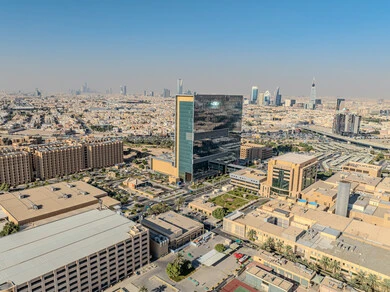
Institutional Overview
- KFSHRC is a premier tertiary-care academic hospital in Saudi Arabia, headquartered in Riyadh, with branches (e.g., Jeddah). Wikipedia+2kfshrc.edu.sa+2
- It’s well-known for specialized medicine: organ transplantation, cardiovascular surgery, oncology, and advanced research. Wikipedia+1
- As per their 2023 annual report, KFSHRC had 1,068 robotic procedures performed across its Riyadh and Jeddah centers. kfshrc.edu.sa
- Their robotic fleet (number of robotic systems) has expanded; by 2023, they had seven robots in use. kfshrc.edu.sa
2. Key Robotic Milestones & Achievements
- First Fully Robotic Living-Donor Liver Transplant: In October 2023, KFSHRC announced a world-first: a fully robotic liver transplant using a living donor. GlobeNewswire
- First Fully Robotic Heart Transplant: In 2024, KFSHRC successfully performed the world’s first fully robotic heart transplant. kfshrc.edu.sa+2kfshrc.edu.sa+2
- Robotic-assisted Artificial Heart Pump (VAD) Implantation: In early 2025, they did a robotic-assisted implantation of a HeartMate 3 device. kfshrc.edu.sa
- Robotic Cardiac Surgery Volume: As of July 2024, they reached 400 robotic cardiac surgeries with a 98% survival rate. kfshrc.edu.sa
- Robotic Liver Transplant (Jeddah): Their Jeddah branch performed the first fully robotic liver transplant in that region, doing both donor and recipient parts robotically. kfshrc.edu.sa+2GlobeNewswire+2
- Robotic Breast Surgery: In 2025, KFSHRC-Jeddah performed the Kingdom’s first robotic nipple-sparing mastectomy with immediate reconstruction. kfshrc.edu.sa
- Pushing Boundaries: According to their own communications, KFSHRC continues to scale up robotics: in 2024 they reported a 28% increase in robotics cases, with 1,370 robotic procedures that year. kfshrc.edu.sa
3. Clinical Domains / Areas of Robotic Application
KFSHRC uses robotics in a variety of very high-complex and specialized areas:
- Cardiac Surgery: Robotic valve surgery, VAD implantation, and now heart transplants. kfshrc.edu.sa+2kfshrc.edu.sa+2
- Transplant Surgery: Liver transplantation (both donor and recipient), including living-donor transplants. GlobeNewswire+1
- General / Oncologic Surgery: As demonstrated by their robotic mastectomy (breast cancer). kfshrc.edu.sa
- Potential Other Specialties: Their annual report mentions urology and general surgery also using robotics. kfshrc.edu.sa
4. Training, Research & Innovation
- KFSHRC is not just doing high-volume robotics — it’s innovating. Their Robotic & Minimally Invasive Surgery Program (especially in cardiac surgery) is led by high-profile surgeons (e.g., Dr. Feras Khaliel). kfshrc.edu.sa
- The hospital emphasizes research and education: new robotic procedures (like fully robotic heart transplants) are part of its mission, not just “do the standard ones.” kfshrc.edu.sa
- Their success in organ transplant robotics (especially liver) demonstrates a focus on very technically demanding robotic work — not routine cases.
5. Patient Impact & Benefits
- Minimally Invasive Transplants: Using robotics for liver transplant (both donor and recipient) likely reduces trauma, bleeding, and recovery time compared to conventional open surgery. GlobeNewswire
- Shorter Recovery & Hospital Stay: For example, their artificial heart pump implantation via robot saw a shorter ICU stay (4 days vs typical ~26) in the reported case. kfshrc.edu.sa
- High Safety / Survival Rates: Their cardiac robotics program’s reported 98% survival in 400 cases is very strong. kfshrc.edu.sa
- Advanced Care for Complex Patients: They handle very complex cases (e.g., redo cardiac surgery, transplant) which might be riskier in traditional open surgery — robotics gives them more precision. kfshrc.edu.sa+1
6. Strategic Strengths & Significance
- Global Pioneer: With first-of-its-kind procedures (like fully robotic heart transplant), KFSHRC is not just following international robotics trends — it’s leading them.
- Regional Leadership: As a major center in the Middle East, its robotic achievements raise the standard of care in the region.
- Alignment with Vision 2030: Their innovation contributes to Saudi Arabia’s healthcare transformation goals (seen in national health strategy documents). Saudi Vision 2030
- Strong Institutional Backbone: Being a major research hospital gives them the capacity to invest in robotics + long-term R&D.
- Scalability: With multiple robotic systems, increasing volume, and a broad scope (cardiac, transplant, oncology), they are building a scalable model rather than a niche robotic program.
7. Challenges / Considerations
- Resource Needs: High-tech robotic surgery (especially for transplantation) requires expensive systems, maintenance, and very skilled surgical teams.
- Patient Selection & Ethics: Transplant surgery using robotics is technically demanding; not all patients may be suitable. The benefit-risk must be carefully evaluated, especially in living-donor contexts.
- Training: Surgeons need very advanced training to do robotic transplants — scaling education and proctorship is non-trivial.
- Sustainability: As they scale up, balancing innovation with cost and institutional priorities will be important.
Leave a Reply